




While Motor Neurone Disease (MND) and Multiple Sclerosis (MS) are both chronic neurological conditions and share some commonalities, they are distinct, with different progress, symptoms, and management strategies.
What is motor neurone disease (MND)?
MND is a group of diseases that affect motor neurones – the nerves cells in the brain and spinal cord that relay instructions to our voluntary muscles (the ones we control with our mind). When motor neurons become damaged and die, muscles grow weak, stiff, and waste, affecting the ability to move, walk, speak, swallow, breathe and, in some people, changing cognitive ability and behaviour. The most common form of MND is Amyotrophic Lateral Sclerosis (ALS).
MND affects everyone differently and symptoms can differ from person to person in their range, onset and progression. This makes the course of the disease a challenge to predict.
MND is life-shortening and while there is currently no cure, symptoms can be managed to help people with the condition have the best possible quality of life. According to MND Australia, research has found that a team-based approach to support and timely treatments can help people with MND ‘live better for longer’. This translates to a dedicated multidisciplinary team comprising specialist doctors, allied health professionals, carers and support workers providing coordinated and tailored interventions, support, and care.
Causes of MND
In the majority of MND cases, the cause is unknown and around five to ten per cent of cases are inherited via a genetic mutation from a parent. Research into causes is being conducted in Australia and around the world and some theories include environmental toxins, chemicals, viral infections, premature ageing of motor neurones, genetic susceptibility, and links to the immune system.
Early signs and symptoms of MND
The first signs and early symptoms of MND can include:
- falls, stumbling or tripping;
- loss of dexterity and weakened grip;
- muscle cramps and spasms (twitching);
- muscle wasting and weakness;
- pins and needles or tingling;
- differences in voice, such as volume or slurring words;
- difficulty swallowing.
MND usually starts in one part of the body and becomes more widespread as it progresses. Where the muscle weakness starts in the body is determined by the motor neurones first affected.
As MND progresses, symptoms can include:
- movement and mobility issues;
- fatigue;
- difficulty speaking (and a condition called dysarthria);
- swallowing difficulties (dysphagia), excess saliva, and difficulty clearing saliva;
- respiratory issues such as breathlessness, fatigue, shortness of breath, drowsiness;
- cognitive and behavioural change (up to 15 per cent of people will experience frontotemporal dementia FTD);
- anxiety and depression;
- pain and discomfort from muscle cramps and/or muscle stiffness;
- insomnia;
- bowel issues.
What is multiple sclerosis (MS)?
MS is a chronic autoimmune disease where the immune system attacks the protective covering of nerve fibres in the brain, spinal cord and optic nerves called the myelin sheath. This delays or blocks nerve impulse transmission, a type of communication between the brain and the rest of the body, causing numbness, weakness, visual loss, and mobility and movement problems.
Causes of MS
The cause of Multiple Sclerosis is unknown, however several risk factors have been identified including:
- genetics, ethnicity, and gender (in Australia, three times more women than men develop MS. This gender difference is only in women post puberty and pre menopause, which has led to researchers investigating the role of sex hormones in the development of MS);
- vitamin D (some studies have linked low levels of vitamin D with the development of MS)
- climate and sun exposure (in Australia, people living in northern Queensland are seven times less likely to develop MS than those living in Tasmania);
- smoking (numerous studies have found smoking and second-hand smoke significantly increases chances of developing MS);
- stress (some studies have linked onset to a stressful event);
- diet and physical activity (people who are overweight have a higher chance of developing MS and people with MS who are overweight have faster onset of progression).
According to MS Australia, understanding these risk factors helps us understand the biology of the disease, which might lead to better treatments and preventions.
Early signs and symptoms of MS
As with MND, early signs and symptoms of MS can differ from person to person. Early signs can include numbness and tingling and optic neuritis, which can cause blurred vision, a blind spot, flashes of light when you move your eyes, and loss of sight.
Symptoms of MS can range from mild to severe and can include:
- tremors and stiff muscles;
- poor coordination and balance;
- muscle weakness and fatigue
- Bladder and bowel problems
- Vision problems such as double vision, blurred vision, loss of sight in one eye,
- Difficulties with speech and swallowing
- Problems with memory and concentration
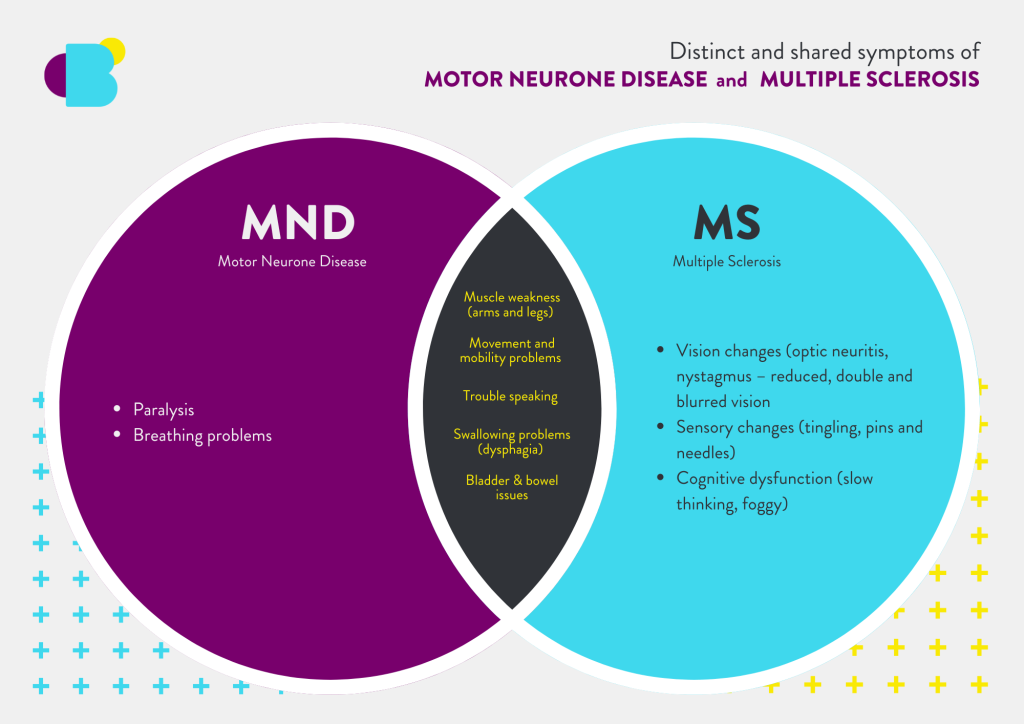
Similarities between MND and MS
The main similarity between MND and MS is that they are both chronic neurodegenerative diseases that affect the central nervous system.
Other commonalities include:
- No cure (research into both conditions is being conducted worldwide to find better treatments, preventions and cures).
- Movement and mobility problems. People with MND and MS can have exaggerated reflexes, reduced motor strength and muscle activation during resistance and gripping.
- The cause of MS and for the majority of people with MND is unknown. (Around 10 per cent of people have a familial form of MND, which means they have or had an affected person in their family).
- MND and MS can cause behaviour and cognition (thinking and memory) changes in some people.
- There is no one test for MND or MS and diagnosis for both diseases can involve reviewing medical history, examinations, medical tests, such as blood tests, lumbar puncture, MRI imaging and, for MS, a diagnosis strategy called ‘differential diagnosis’, which rules out other conditions with similar signs and symptoms.
- There are different types of MND and MS. There are two types of MS, including Relapsing Remitting MS and Primary Progressive MS, and five types of MND, which largely relate to the parts of the body that the disease affects (people can change types over time and Amyotrophic lateral sclerosis (ALS) is the most common type. It’s also one of the most well-known types thanks to the global phenomenon ALS Ice Bucket Challenges of 2014 that promoted awareness of the disease and raised over $115 million for The ALS Association).
- People with MND and MS experience challenges in daily life as both diseases can significantly impact movement, mobility, and independence.
- People with MND and MS can benefit from support for medical complications and physical function, including a multidisciplinary approach to support, with tailored programs from allied health professionals.
Differences between MND and MS
The main difference between these two conditions is that MS is a chronic autoimmune disease whereas MND is a group of diseases that cause motor neurones to become damaged and die.
Other differences include:
Incidence
Generally, MS is more common than MND. In Australia, more than 33,300 people are living with MS and one to two are diagnosed with MS every day. According to the Brain Foundation, MND is ‘uncommon but not rare’, with over 2000 people in Australia with MND and two Australians diagnosed with MND each day.
Symptoms
People with MND don’t experience numbness, unlike some people with MS.
Also, MS can cause vision problems whereas MND does not affect the optic nerves and therefore eyesight, nor the other senses of hearing, taste, smell, and touch.
Age of onset
Adults and children can have MND and symptoms can appear in early childhood. While onset of MND can happen at any age in adults, most are diagnosed after the age of 40 and MND is common in those aged between 50 and 70.
The average age of onset of MS however is between 20 and 40 years.
Early signs
The first signs of MS can include numbness and tingling and vision problems, or optic neuritis, both caused by nerve damage. The first sign of MND is often weakness in the muscles of the hands, feet or voice.
Male to female ratio
In Australia, there are three times more women than men with MS while there are currently more men than women with MND (60 per cent male to 40 per cent female).
Progression
People with MND experience rapid progression of the disease, and although the speed of progression varies for each person, there are no periods of remission or relapses.
MS, however, progresses more slowly than MND, and progression also varies from person to person. For most people, MS starts with relapses – sudden onsets of new symptoms or worsening of existing symptoms – while others experience a steady progression of symptoms.
As muscles deteriorate, people with MND experience muscle paralysis and need assistive devices to help them maintain mobility such as walkers, wheelchairs or scooters. By comparison, most people with MS experience mild or moderate muscle weakness and rarely experience paralysis.
Life expectancy
Life expectancy for people with MS is only slightly reduced, however MND is life-shortening. For most people with MND, the average survival time following diagnosis is two and a half years and a minority of people living five years or more.
Treatment
Pain relief and anti-anxiety medications, vitamins, dietary changes, and alternative therapies are used to manage the symptoms of MND. And while there are currently no pharmaceutical drugs that can cure or reduce the severity of MND, allied health interventions can improve quality of life.
Allied health professionals can also help reduce the impact of MS on quality of life and there are several medical MS treatments, including disease-modifying therapies (DMTs) that can slow progression and reduce the occurrence of relapses and manage symptoms, and steroids to reduce nerve inflammation during relapses.
Allied health professionals who are qualified and trained to support people with MND and MS
Physiotherapists
Physiotherapists create personalised exercise programs to enhance mobility, movement, health and safety of people with MND and MS.
For people with MND, physios focus on maintaining mobility and movement and preventing complications like muscle stiffness, chest infections. They can also provide techniques to help support respiratory health, aid to improve breathing, and advise family and carers on safe movement, such as moving from a chair to a bed.
For people with MS, physios can create personalised exercise programs to
- improve strength, fitness, mobility and balance;
- improve health and wellbeing;
- manage fatigue, weakness, stiffness, pain, and bladder problems;
- increase independence and participation in daily activities;
- prevent some symptoms worsening over time and secondary complications such as muscle shortening and chest infections.
Occupational therapists
Occupational therapists (OTs) can help people living with MS and MND by providing personalised adaptive strategies, such as different ways to perform daily tasks and advice on home modifications and assistive technology (equipment and devices) to aid in daily living and enhance independence, safety and quality of life.
For people with MS, OTs focus on supporting them to participate in valued and meaningful daily activities, such as personal care, cooking and working. Interventions may include different ways to perform tasks and assistive technology and home or work modifications to help people with MS live independently and move around their home and community more easily and safely. OTs can also help people manage fatigue and reduce secondary conditions developing.
Speech pathologists
For people with MND, speech pathologists can help them overcome swallowing difficulties so they can eat and drink more effectively and safely, and also help them communicate when they experience speech difficulty and loss by providing advice and tuition on Augmentative and Assistive Communication (AAC) devices, such as boards and tablets, including those with eye-tracking software. It can be challenging to become adept using any new device, so it’s not surprising that studies have found that training and support are essential for helping people with MND to use and fully benefit from ACC devices.
For people with MS, speech pathologists can assist in managing speech difficulties and cognitive communication impairments, which can include slower information processing and ‘word finding’ and reduced memory function, attention, concentration, and executive functioning, which is needed for planning, problem-solving, remembering, and managing multiple tasks.
MS causes speech difficulties as the condition can affect the diaphragm, making it a challenge to control breathing and volume of speech (called dysphonia), and the muscles of the tongue and lips needed to produce the sounds of speech (or articulation). When a person has MS, their speech can sound slurred, which is known as dysarthria, or be halting, monotone and lack control in delivery, which is called ataxic speech.
Talking to an AHP is the first step to getting the right support
There’s no doubt that support from the right professionals is key to helping people with MND and MS live a better quality of life. If you or a loved one has been diagnosed with MND or MS, our allied health professionals can arrange an appointment at our clinic or in the comfort of your home to discuss your personal needs, situation and goals. They can recommend one or more clinicians and walk you through the ways they can support you and work collaboratively with your specialist doctors, family, carers and support workers.
We encourage you to fill out our referral form so a member of our team can get in touch with you.


