



Since 1 October 2026, every new or reassessed NDIS plan carries 10% less spendable funding for Improved Daily Living, and 50% less funding for social, economic and community participation. For Support Coordinators, that changes the question. It’s no longer only “what help does this participant need?” It’s “which supports will build skills that last?”
When we talk about independent living, the conversation often stops at cooking, cleaning and laundry. Those skills matter. But whether someone can live safely, with less support over time, also depends on what they do when the smoke alarm goes off at 2 am, when a stranger knocks at the door, or when a text asks for their bank details.
These are the skills our occupational therapists (OTs) assess and build. Done well, our capacity building service now means fewer paid supports later, and a participant who stays safe when no one else is there.
What changed on 1 October, and why it matters for daily living
The NDIS support determinations commenced on 1 October 2026. Here’s what Support Coordinators need to know:
- Improved Daily Living is reduced by 10%, and social, economic and community participation is reduced by 50%. Other budgets, including capital AT and home modifications, are not affected.
- It rolls out over 12 months. It applies to new and reassessed plans from 1 October 2026, renewals from 1 February 2027, and all affected plans by 30 September 2027.
- It can’t be topped back up. The reduction is set in law. No report or review reverses it, and the reduction alone isn’t grounds for a reassessment.
- Some supports are protected. Supports in employment, high intensity supports and intensive behaviour supports are excluded. Participants with 24-hour NDIS-funded support may be eligible for a new variation pathway.
Two practical consequences follow. First, every hour of capacity building now has to earn its place. Second, with community participation funding halved, many participants will spend more time out and about, and at home, without a support worker. The skills to stay safe in those hours matter more than ever.
The case for capacity building: skills now, fewer supports later
Capacity building is the one part of a plan designed to make itself smaller over time. Core supports do things for a participant. Capacity building teaches the participant to do them, safely, so that support can step back.
Here’s what that looks like in practice:
- A participant who can respond to a smoke alarm and call 000 may no longer need active overnight support.
- A participant who manages their own medication routine may need fewer prompting visits each week.
- A participant who can travel a familiar route independently may not need a support worker for every trip, which matters even more now that community participation funding has been halved.
That’s the argument Support Coordinators need when funding is tighter. A smaller Improved Daily Living budget spent on targeted, measurable skill-building can reduce what a participant needs from their core budget. It can also protect their safety when paid support isn’t there.
The key word is targeted. With 10% less to spend, open-ended weekly therapy is harder to justify. A focused block, with a clear baseline, specific goals and a plan for fading support, gives the participant the most for their funding and gives the NDIA the evidence it looks for.
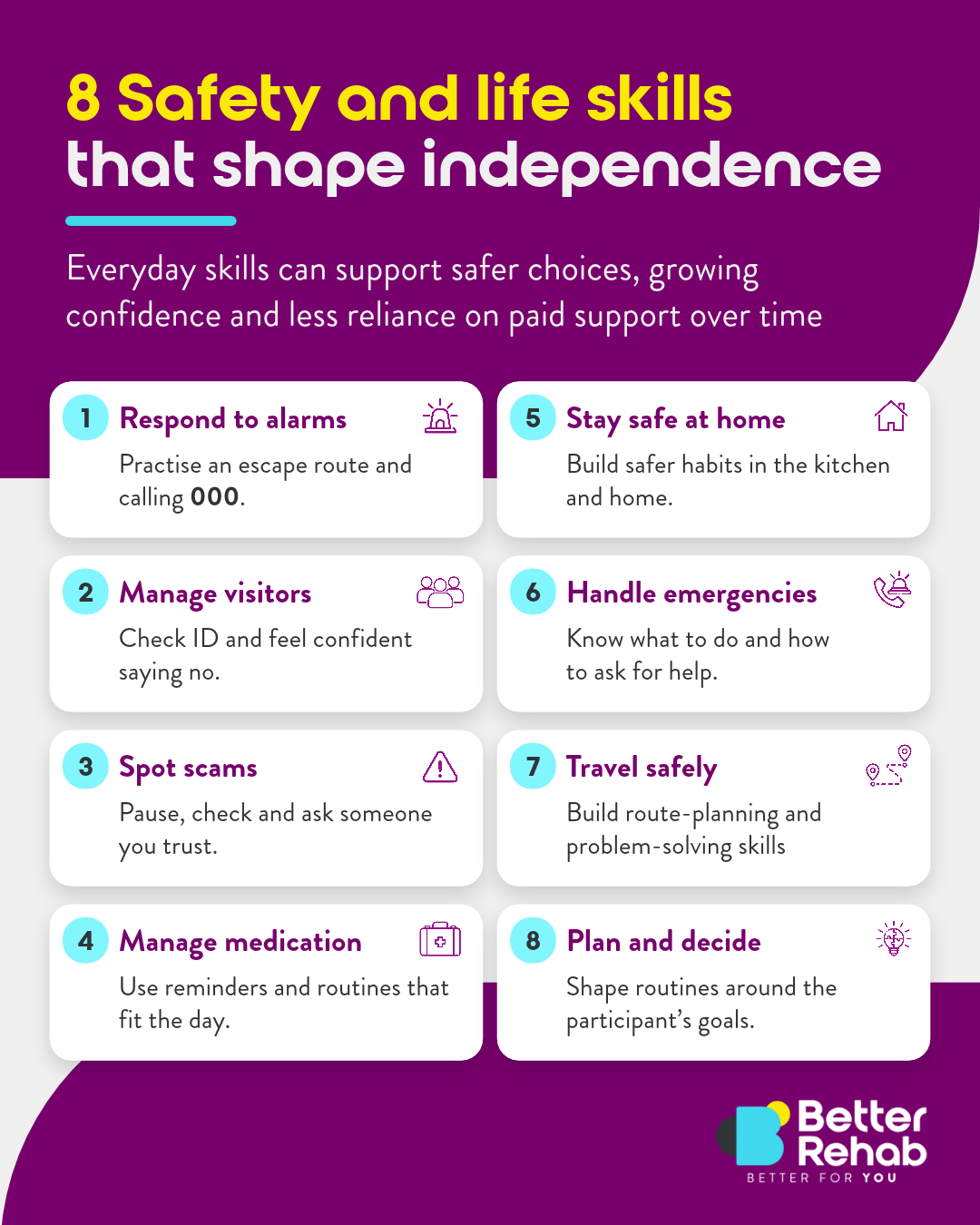
8 safety and life skills that build lasting independence
For each skill below, you’ll find the risk, what our OTs actually do, and what the participant gains.
1. Responding to a fire or smoke alarm
The risk: A national study of coronial records found 420 of the 900 people (46.7%) who died in preventable house fires between 2003 and 2017 had at least one disability (Bushfire and Natural Hazards CRC, 2019).
What our OTs do: We observe the participant’s real response to an alarm in their own home, including whether they hear it or wake to it. We then practice a planned escape route until it’s automatic. Our in-house assistive technology specialists can prescribe specialised smoke alarms, such as strobe or vibrating alarms, where a standard alarm won’t work.
The payoff: A participant who reliably evacuates and calls 000 is safer alone, and has stronger evidence for living with less overnight support.
2. Managing visitors at the door
The risk: Opening the door to anyone can expose a person to pressure selling, theft or exploitation, particularly if they live alone.
What our OTs do: We use role-play and visual scripts to practice checking ID and saying no, then test the skill in a real situation. Where it helps, we recommend a video doorbell and teach the participant to use it.
The payoff: Confidence to manage visitors without someone else present.
3. Spotting scams and protecting money
The risk: People with disability reported $20.8 million in scam losses in 2024 (ACCC Scamwatch). Job scam reports from people with disability rose 114% in 2025 (National Anti-Scam Centre).
What our OTs do: We assess money management in everyday tasks, then build a simple “pause and check” routine with the participant and the people they trust. This follows a supported decision-making approach: the participant keeps the choice, with the skills and safety net to make it well.
The payoff: Protected funds and greater financial independence, with less need for others to manage money on their behalf.
4. Managing medication and health
The risk: 29.6% of people with disability living in households need help with health care (AIHW).
What our OTs do: We look at how the participant’s day actually runs, then set up reminders, organisers or visual schedules that match how they learn. We work alongside their GP and pharmacist, who manage the medication itself, for example through dose administration aids.
The payoff: Fewer prompting visits, and fewer missed or doubled doses.
5. Staying safe in the kitchen and around the home
The risk: Fire and Rescue NSW lists living alone and clutter among the factors that raise home fire risk.
What our OTs do: We complete a home safety assessment and combine skills training with practical changes. Our home modification specialists can recommend minor home adaptations, such as stove shut-off devices, or more complex modifications.
The payoff: A safer home where the participant can cook and live with less supervision.
6. Handling an emergency and asking for help
The risk: 24.8% of people with disability living in households need help with cognitive or emotional tasks (AIHW), which can make problem-solving under pressure harder.
What our OTs do: We rehearse emergency steps, such as a fall or a power outage, and create an emergency information card. We assess whether a personal alarm would help. Where communication is a barrier, our speech pathologists can work with the participant on giving their name and address clearly over the phone.
The payoff: A participant who knows what to do, and how to get help, when no one is there.
7. Getting around the community safely
The risk: 24.7% of people with disability living in households need help with mobility (AIHW). With community participation funding halved, fewer outings will come with a support worker.
What our OTs do: Our travel training builds skills step by step, from a set route to managing a cancelled train or a wrong turn. We focus on the planning and problem-solving parts that are hardest to learn. Where driving is a realistic goal, our OT driving assessors can help.
The payoff: The participant keeps getting out into their community, even with fewer supported hours.
8. Planning routines and making decisions
The risk: Without the skills to organise their week, participants can become reliant on others to structure each day.
What our OTs do: We break routines into manageable steps and build planning and problem-solving skills, always led by the participant’s own goals. Australian research describes daily living skills as key to quality of life “regardless of neurotype” (Morrison, Cashin and Foley, Australian Occupational Therapy Journal, 2025).
The payoff: A participant who directs their own day, with support that fits around them rather than running it.
Signs a participant may benefit from an OT review
Use this checklist in your next conversation with a participant, their family or their support workers.
- Relies on others to respond to alarms, or has never practiced an escape plan
- Opens the door to anyone, or has had unwanted visitors
- Has lost money to a scam, or shares PINs and passwords
- Misses or doubles up on medication, or misses appointments
- Leaves the stove on, places heaters near furniture or has cluttered exits
- Is unsure how to call 000 or give their address
- Will have fewer supported hours in the community after their plan is reassessed or renewed
- Is moving out of the family home or into a new living arrangement
- Has had a hospital stay, a change in health or a change in informal supports
- Has goals about living independently, but the plan mainly funds help with domestic tasks
If you said yes to any of these, a targeted OT assessment could help the participant get the most from their Improved Daily Living funding.
Make a referral or call us on 1300 073 422.
Why Support Coordinators refer to Better Rehab
When funding is tighter, you need a provider who makes every hour count, and who gives you evidence you can use. Here’s what you get when you refer to us.
- We plan therapy around the funding the participant can actually spend. Since 1 October, the amount printed in a plan and the amount a participant can spend may differ. We check the spendable Improved Daily Living amount before we propose a block of therapy, so there are no surprises halfway through.
- Focused blocks, not open-ended therapy. Every block starts with a functional baseline, sets measurable goals linked to the participant’s plan, and includes a plan for fading support.
- Reports built for NDIA decisions. Our reports are comprehensive, addressing the NDIS reasonable and necessary criteria by clearly outlining what capacity the participant has, where their skills are developing , and what support they need.
- Specialists under one roof. Our national OT team includes assistive technology prescribers, home modification assessors, and OT driving assessors (including vehicle modifications). When a safety recommendation needs equipment or a modification, the same team can assess and prescribe it.
- One team across five disciplines. If a participant would also benefit from Speech Pathology, Physiotherapy, Exercise Physiology or Positive Behaviour Support, we coordinate it in-house, so you don’t have to manage multiple providers.
- OTs where your participants live. We have OTs in every state and territory, seeing participants in their homes and communities, with telehealth where it suits.
- Clinical quality you can trust. Every Better Rehab OT has regular clinical supervision and ongoing professional development, overseen by a national clinical leadership team. This supports evidence based best practice – directly resulting in better outcomes for your participants.
What to include in your referral
- The participant’s goals
- Their current plan dates and the Improved Daily Living funding you would like to allocate
- Any recent reports or assessments
- Any safety concerns you’ve noticed (using the checklist above is a good start)
- Any upcoming changes, such as moving house or a plan reassessment
What happens next
We’ll contact you to confirm funding, timeframes and the right assessment. Your participant’s OT will keep you updated throughout, and you’ll receive a copy of any reports to ensure a smooth end of plan experience.
Frequently asked questions
- With 10% less Improved Daily Living funding, is an OT assessment still worth it? Yes, if it’s targeted. A focused assessment and skills block can reduce a participant’s reliance on core supports, which is the best use of a smaller capacity building budget. We’ll help you weigh it up against what the participant can actually spend.
- Can an OT report reverse the funding changes in a plan from the Support Determination? No. The reduction is set in law and applies to every affected plan. What OT evidence can do is show what a participant needs when something else has genuinely changed, such as a move, a hospital stay or a change in informal supports.
- Does the reduction mean a participant should ask for a reassessment? Not on its own, because the reduction by itself isn’t considered a significant change in circumstances. A reassessment is a decision for the participant, ideally with support from you or an independent advocate. This change to their funding makes capacity building more important than ever before.
- What if the participant has 24-hour support? Participants with 24-hour NDIS-funded support who meet the eligibility criteria can apply for a plan variation within 90 days of the reduction. Any increase goes to daily living or home and living supports. An OT report can support the application. This pathway doesn’t cover 24-hour support provided by family or informal carers.
- Can a Support Coordinator arrange an OT assessment? Yes. You can help a participant choose and engage an OT. Assessments can be funded from Capacity Building: Improved Daily Living, so check the plan has funds available first.
- How quickly can you start? We’ll confirm timeframes in your area when you make a referral. If a plan reassessment is coming up, refer early so there’s time to complete the assessment and report.
- Does a participant need to live alone to benefit? No. These skills matter for anyone building more independence, including people in shared living, and anyone who will have fewer supported hours in future.
Want to speak to us about this in more detail? Call us today on 1300 073 422 or make a referral today to get started.
Sources
- Department of Health, Disability and Ageing. Funding changes for NDIS supports. September 2026.
- Department of Health, Disability and Ageing. Funding changes for NDIS supports: Safeguards for high support needs participants. September 2026.
- Office of Impact Analysis. Implementation of Support Determinations in NDIS old framework plans: exclusions and safeguards. September 2026.
- National Disability Insurance Scheme (Support) Determination 2026 (F2026L01332). Commenced 1 October 2026.
- National Disability Insurance Scheme (High Support Needs Participants) Determination 2026 (F2026L01331). Commenced 1 October 2026.
- National Disability Insurance Agency. Securing the NDIS for future generations. September 2026.
- People with Disability Australia. More NDIS changes from 1 October: what you need to know. 2026.
- Australian Institute of Health and Welfare. People with disability in Australia: Need for assistance with activities. 30 June 2026.
- National Disability Insurance Agency. Our Guidelines: Therapy supports. 27 July 2026.
- National Disability Insurance Agency. Our Guidelines: Individualised living options. 10 September 2026.
- National Disability Insurance Agency. What are capacity building supports? Current 16 July 2026.
- NDIS Quality and Safeguards Commission. Fire Safety Measures Provider Alert. December 2024.
- Coates L, et al. Preventable residential fire fatalities in Australia July 2003 to June 2017. Bushfire and Natural Hazards CRC. August 2019.
- Fire and Rescue NSW. Fire and Rescue NSW identifies people most at risk of a home fire this winter. 20 June 2025.
- ACCC Scamwatch. Australians better protected as reported scam losses fell by almost 26 per cent. 11 March 2025.
- National Anti-Scam Centre. Targeting scams report 2025. March 2026.
- Morrison C, Cashin A, Foley K. Daily living skill support for autistic people through a neurodiversity-affirming practice lens. Australian Occupational Therapy Journal, 72(2). 2025.


